A-Z OF DISCIPLESHIP COURSE
6 SESSIONS
You can access each week of the course (in pdf format) by clicking the links below:
Alternatively you can view the whole course (ie. all 6 sessions) below.
A-Z OF DISCIPLESHIP COURSE
6 Sessions
Week 1 of 6
Before You Start
This 6-week course will take us on a whistle-stop journey through the basics of discipleship. Ensure you have a Bible.
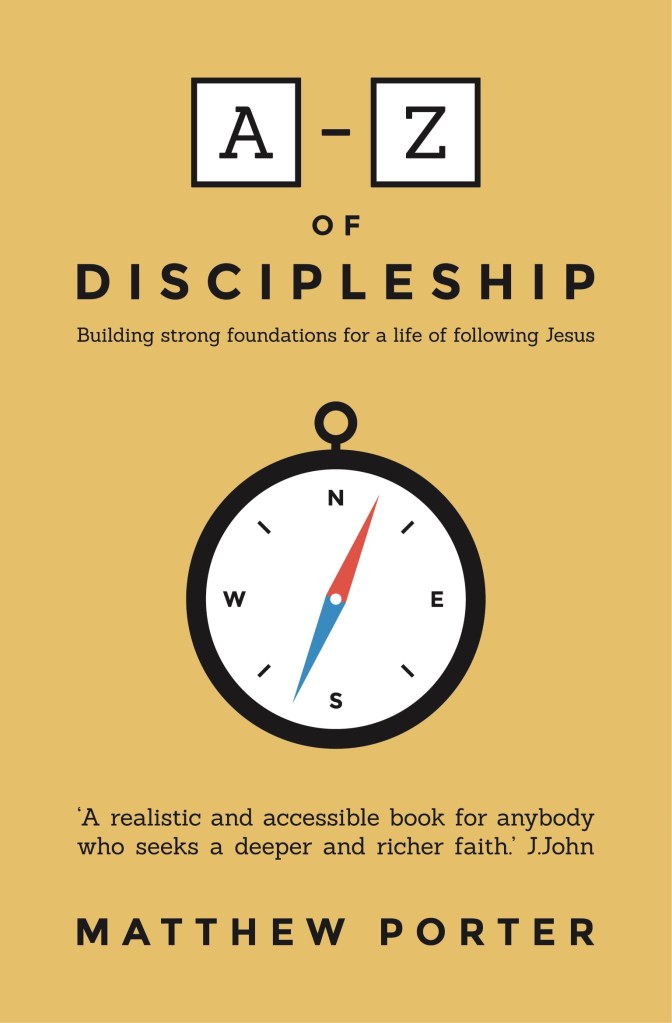
We’ll be guided by Matthew’s simple book, A-Z of Discipleship. You will get the most out of this course if you’ve read or listened to the relevant chapters before-hand. However those who haven’t will still be able to engage with the material.
To purchase the A-Z of Discipleship book online, click here.
To watch or listen free to A-Z of Discipleship being read on Youtube by Matthew, click here.
Each weekly session is designed to take 70 minutes (ie. 1 hour and 10 minutes), so do make time for this. This allows 10 minutes for discussion on each section, which is not long. So the leader should be mindful of this in leading, prayerfully considering when it’s right to move on, or whether it’s important to stay a little longer on a particular section and shorter on another.
WEEK 1 – INTRODUCING DISCIPLESHIP
Discipleship is the daily practice of following Jesus. It’s an exciting adventure to which all Christians are called. Discipleship is something we do every day, and it requires practice. At its heart is a person – the person of Jesus Christ. That’s why Jesus is mentioned on most pages in Matthew’s book: A-Z of Discipleship.
This is the first week of the 6-week A-Z of Discipleship Course. Today we will introduce the topic of discipleship.
Preparation
Before you meet, read chapters A and B of A-Z of Discipleship and, if you have time, any of the Foreword, Preface and Introduction.
Begin (15 mins)
The leader should ensure that everyone is welcomed. Go round the group and make sure everybody knows each other’s names. Then go round the group again and ask people to share a fascinating fact about themselves. Now go round one final time, and ask everyone to share a word or phrase that comes to mind, when they think about Jesus.
Talk about this course. The leader should make it clear that we don’t have to have read the relevant sections in A-Z of Discipleship to be able to engage with this discipleship course, but that it helps. The most important thing is that we put the material in this course into practice. That’s the way to grow and mature as disciples of Jesus.
Start by reading John 13:35, and then pray for everyone, that together the group would be marked by love – as the group grow in love for each other, and for Jesus Christ.
Introduction (20 mins)
Talk in pairs or threes, sharing your hopes for this course. Then look at this definition of discipleship (on p.1 of A-Z of Discipleship): ‘Discipleship is the daily practice of following Jesus.’ Talk about that definition. What is exciting about it? And what is challenging?
Now get people back into one group. Feedback to each other about your conversation. In particular talk about what it means to really ‘follow’ Jesus: to let him lead, direct and guide your life.
At the end of the Preface, Matthew says he hopes people will ‘capture a vision for a lifetime of discipleship that’s not only personally fulfilling but, more importantly, changes the world.’ What do you make of this? Is this what you want?
Discussion (20 mins)
1. A is for Abba
Followers of Jesus worship God, who is described in the Bible as ‘Abba’ – which is the intimate name a son or daughter in near-eastern culture would call their father. As we get to know Jesus, we get to know his Father, who carefully made us and, unlike human fathers perfectly loves us, and mercifully sent Jesus to die for our forgiveness. Spend some time talking about this good God and how Jesus reveals the love of God the Father. Look at bible verses such as Matthew 6:9; Romans 8:14-16 and John 14:9. Are you starting to get to know this Father, as you follow Jesus? Are you sensing the presence of his Spirit, pouring the Father’s love into your heart?
2. B is for Bible
The Bible is very important to disciples because it is the message of God’s love and is alive (Hebrews 4:12). As we are prayerful and open our lives to Jesus, so his Spirit communicates with us, especially through the Bible. Look through the index of a Bible, noticing the Old Testament and New Testament and seeing how it fits together. Then read 2 Timothy 3:16-17 and see what the Bible says about itself. What do you make of it being ‘God-breathed?’ How does it say it is useful? What has God said to you recently as you have read the Bible? Why is it good to read the Bible every day?
Pray (15 mins)
End by spending some time in worship and prayer.
First ask if there is anyone who isn’t yet a follower of Jesus, but who would like to be. If so, make time to lead them in a prayer to start following Christ – eg. thanking God for sending Jesus to die for them; saying sorry for all the wrong in their lives, and asking God to forgive them, and fill them with his presence and love. Encourage them that they are now a follower of Jesus, and adopted into God’s family.
Then encourage everyone to participate in prayer, praying from the heart to Jesus, even if it’s just a short sentence or two. They might like to pick up phrases from the Bible that have been looked at earlier. Together you could use a ‘thank you, sorry, please’ model of praying (as above). So encourage everyone to thank God being a good Father. Then say sorry for selfishness, praying, as Jesus taught his disciples: ‘forgive us our sins’ (Matthew 6:12). Then ask if anyone has any particular prayer needs, and pray for each other. End by asking that the Spirit of God would speak as each one as they read the Bible in the coming days.
Week 2 – Rooted Discipleship
This week we’ll look at some important topics which will help followers of Jesus put down strong discipleship roots.
Preparation
Before you meet, read chapters C, D, E, F and G of A-Z of Discipleship.
Begin (10 mins)
Ensure that everyone is welcomed and encourage them to keep pursuing the adventure of discipleship. You might like to ask how what they have discovered about discipleship since the last meeting, and what they have found helpful or difficult as they’ve read the Bible.
The leader should then read Mark 1:16-20 and remind everyone that being disciples is, in the end, about laying down our agenda, and following Jesus. Then pray for everybody, that the Spirit of Jesus would continue to be our teacher as we learn about discipleship.
Discussion (50 mins – ie. about 10 minutes on each)
1. C is for Church
No-one is called to be a disciple in isolation. Instead we’re meant to grow as disciples together in the family of God’s church. So what is ‘church’ according to the New Testament? Look at Bible verses such as 1 Corinthians 3:9 and Ephesians 2:19-22 to help. Are you part of a local church? If not, why not? Acts 2:42-47 describes an inspiring model of church, so how could you help make your church more like this first church?
2. D is for Disciplines
To grow in discipleship requires training. God has provided some key disciplines to help us mature. Three of these are listed in Matthew 6. Look at vv2, 5 and 16 to see what they are. Talk about them. Does Jesus say they are optional extras, or part of discipleship? In A-Z of Discipleship, Matthew especially focusses on fasting, as it’s a basic but much neglected discipline, but don’t neglect others too, like daily Bible reading and prayer. Practicing these disciplines doesn’t make God love us any more (he can’t love us any more or less!), but they do please him because he knows they are good for us. Read 2 Timothy 1:7 to see what the Bible says about the link between the Holy Spirit and disciplines.
3. E is for Encourage
How often should disciples encourage others, according to 1 Thessalonians 5:11? Why do you think encouragement is so important for disciples? Read Acts 11:22-24 and take note of how Barnabas encouraged others. What was the result? Think of someone you can encourage today.
4. F is for Faith
Faith is not a concept or a ‘thing’ – rather it is believing in someone or something. Followers of Jesus put their faith in Jesus. According to Jesus in Matthew 17:20, how much faith do we need for God to move in power? On p.36 of A-Z of Discipleship, Matthew says: ‘What’s most important is not that we have great faith but faith in a great God.’ Talk about this, and about the importance of exercising faith.
5. G is for Giving
God is a generous God, freely giving good things. What does John 3:16 say is the most significant thing God has given? If God is generous, so should disciples be. So what hinders generosity? Read 2 Corinthians 9:6-11 to see how God honours generosity. What happens as we give?
Pray (10 mins)
End this session by asking everyone to chose at least one thing they want to do differently, in the light of today’s material. Then go round and briefly share these things, for encouragement and accountability. Now turn to prayer, and encourage group members to pray for each other, asking that the Holy Spirit would help everyone put these things into practice.
Close by thanking God for everyone in the group, person by person. Encourage each one, if possible, with a word of Scripture or a short prophetic word, as they leave.
Week 3 – Core Discipleship
In this session we will look at five topics that are central to being a disciple.
Preparation
Before you meet, read chapters H, I, J, K and L of A-Z of Discipleship.
Begin (10 mins)
Ensure that everyone is welcomed. Give just a few minutes to one or two questions or reflections people have had, as they’ve journeyed in discipleship since the last session.
After this read 2 Timothy 1:7 (looked at last time), giving thanks to the Holy Spirit who gives us power, love and self-control. As we look further at some core aspects of discipleship in this session, pray for his help and guidance as we seek to go further in discipleship.
Discussion (50 mins – ie. about 10 minutes on each)
1. H is for Holy Spirit
The Holy Spirit is ‘God’s empowering presence.’ He is God – real and true and at work. Read some Bible verses about Him: eg. Acts 1:4-5; Acts 2:1-4; John 16:7-11. What do you discover? He grows fruit in our lives (see Galatians 5:22-23) and loves to give us gifts that we need for a variety of situations (see 1 Corinthians 12:7-11). Do you want to be immersed in his Holy Spirit (either for the first time, or again)? If so, ask in prayer – either now, or at the end of this session.
2. I is for Identity
One thing the Holy Spirit loves to do, when we begin following Jesus, is tells us who we now are: that we are no longer people separated from God, but included in his family (see Colossians 1:21-22). What do 1 Peter 2:9 and Ephesians 2:10 say about our identity? How does it felt be his beloved children, adopted into his royal family, knowing God is pleased with us? Even when we sin, or times are hard, God still loves us and wants us to grow and get stronger, like children. The Bible says (in 2 Corinthians 5:17) that we are ‘new creations.’ Praise God!
3. J is for Jesus
Jesus is central to discipleship: he is amazing, and we follow him! He shows us what God is like, and His life, death, resurrection, and ascension are at the heart of the Christian faith. Ask everyone to share one thing they have discovered about Jesus recently. Look at some of the names of Jesus listed at the top of p. 60 of A-Z of Discipleship, and if time some of the Bible verse linked to them. Which ones stand out and why?
4. K is for Kingdom
Followers of Jesus are part of God’s kingdom. We come under his kingship and seek to live by kingdom values. This kingdom will be fully experienced in heaven, beyond the grave (Revelation 21:3-4). Until then, Jesus told his followers to pray and work for God’s kingdom to come here on earth, as in heaven (Matthew 6:10). Talk about this and its implications. Jesus loved to tell short stories (parables) to help us grasp what God’s kingdom is like. Ask one or two in the group to say if there is a kingdom-parable they have found particularly enlightening.
5. L is for Love
God is full of love, and the perfect example of love is found in the person of Jesus. Read 1 John 4:9-11 and talk about how God shows this love to us in Jesus. What happens when we find it hard to love people? (Hint: the Spirit of Jesus has lots of love to give – see Galatians 5:22 and 2 Timothy 1:7 – so why not ask?)
Pray (10 mins)
End in prayer. Begin by thanking God for Jesus, and that our identity as disciples is based not on how good we are, but on how good he is. Spend some time praying for each other – for a fresh immersion in the Holy Spirit for each one, and that Christ’s love would flow in and from us, bringing his kingdom into all sorts of situations in the coming days.
Week 4 – Everyday Discipleship
This week we’ll spend time considering some practical aspects of being a follower of Jesus in contemporary society.
Preparation
Before you meet, read chapters M, N, O, P and Q of A-Z of Discipleship.
Begin (10 mins)
Ensure that everyone is welcomed. Spend a few moments talking about being stretched in discipleship. In the same way that we stretch a muscle for it to get stronger, so the Lord wants to strengthen you as a disciple. However that stretching can feel like hard work – rather like when we work out a muscle and it aches afterwards! So ask one or two to share how they are being stretched in discipleship at present, and finding it good!
After this read Ephesians 3:20-21 and thank the Lord that he is the God of ‘immeasurably more’ and pray that each of us would grow even more as disciples through this session.
Discussion (50 mins – ie. about 10 minutes on each)
1. M is for Mission
Disciples of Jesus are called to show and tell of His love in word and action. In Mathew 28:18-20 Jesus invites his disciples to make more disciples. Read this passage and notice what Jesus asks us to do. Who told you about the love of Jesus? And who are you going to tell? Why do you think it’s important to not just talk about, but demonstrate God’s love in practical, kind ways too? If time, read Matthew 25:31-46 and talk about its implications.
2. N is for New
While God values the old, he also loves the new. What new things is the Holy Spirit doing in you? Read 2 Corinthians 5:17 and talk about the renewing work God wants to bring to people and to the world, through us. Does that excite you? As we are captured by the thought of the new ‘holy city’ in heaven that we will one day enjoy, so allow God to envision you for renewal here on earth, in our day. Where and how can you join in?
3. O is for Obedience
Obedience is highly underrated in many sectors of life today, but for followers of Jesus, obedience is basic and central to discipleship. Read the story of the calling of Simon Peter, in Luke 5:1-11 and talk about the benefits this disciple receives as a result of his obedience. What do you make of the idea, at the end of Chapter O, that maturing as a disciple is a slow work of the Holy Spirit, as we co-operate in obedience?
4. P is for Prayer
Prayer is communicating with God. We pray because God is real, powerful and close, and he loves to hear our prayers. Read Matthew 6:5-15, which is Jesus’ basic discipleship training on prayer. In particular take note of how Jesus encourages us to pray in the Lord’s Prayer. What do you notice? Do you use these themes as a springboard to further prayer? Are there some new ways to pray here?
5. Q is for Quarrel
This side of heaven there will be conflict. We don’t go looking to create it, but there will be quarrelling. It even happens inside church sometimes. What do you make of Jesus’ 4-fold process of dealing with conflict, as set out in Matthew 18:15-20? Why do you think many speak last with the person who’s hurt them, rather than first? Is there someone you need to go and see to put things right?
Pray (10 mins)
End by praying. Go through the Lord’s Prayer together, phrase by phrase, pausing to allow people to pray some short prayers to God. Thank God for he forgiveness everything, and ask him to help you forgive those who have hurt you. And don’t be afraid to ask God for things: so when you get to ‘give us today our daily bread’ share needs and ask God to help. Also pray for loved ones who are not yet followers of Jesus. Pray for opportunities, this week, to show the love of Jesus in action, and to speak of Jesus in your words.
Week 5 – Transformative Discipleship
This week we’ll be looking at further aspects of discipleship, especially focussing on how following Jesus brings transformation to us and others.
Preparation
Before you meet, read chapters R, S, T, U and V of A-Z of Discipleship.
Begin (10 mins)
Ensure that everyone is welcomed. Also, does anyone have any answers to prayer to share? Listen and give thanks. Ask how people found last week’s session, especially the section on mission. Theologian Mike Riddell says, ‘Apart from involvement in mission, the church becomes a tawdry relic; a dusty museum of religion, suitable for tourists and historians, but little else.’ Do you agree?
After this read Romans 12:1-2 and ask the Lord to help everyone continue to ‘be transformed’ as God renews our minds, and then our hearts and wills.
Discussion (50 mins – ie. about 10 minutes on each)
1. R is for Repentance
Repent means change. We start following Jesus by repenting, and then continue to change and repent as we grow more Christ-like. Read Mark 1:14-15 and reflect on Jesus’ call for people to repent. He does this because he loves us and wants good things for us. Talk about this, and how you have been changing, since starting to follow Jesus. Be open and honest.
2. S is for Sacraments
A sacrament is an outward sign of a visible reality. When we start following Jesus we mark it with the sacrament of baptism. Read Romans 6:3-4 and talk about what baptism stands for. Have you been baptised? If not, why not? Once we’re baptised, we don’t keep getting baptised as a sign of following Jesus; instead we regularly take bread and wine in Holy Communion. Read 1 Corinthians 11:23-26. Are you taking Communion? These very ordinary physical things are powerful means of us showing our love for Christ, and of him drawing close and filling us with his presence and power.
3. T is for Trinity
God is Trinity: Father, Son and Holy Spirit. Read the ‘Action’ section at the end of Matthew’s Chapter T, and do what it says: ‘Read the story of Jesus’ baptism, beginning at Matthew 3:13. Take some time, reading it slowly and a few times. Write down what you notice about the three persons of God and how they work together in this amazing story.’ The Trinity work closely together, supporting and loving each other. What do you make of this, and what does this teach us about how we might thrive in our human relationships?
4. U is for Underprivileged
Caring for disadvantaged and underprivileged people is important to followers of Jesus, because it’s important to God. Read Luke 4:16-21 and the corresponding Old Testament passage, in Isaiah 61:1-3. What does this show of God’s love for those who struggle? What should disciples do?
5. V is for Vision
God gives vision, so we have clarity about what he’s asking of us. Read Habakkuk 2:3, Proverbs 29:18 and Ephesians 1:18. Do you sense God has given you vision for your life, your family, and your work? Talk about this, and make sure later, in prayer, you ask the Lord to turn this vision into reality.
Pray (10 mins)
Now turn to prayer. Spend a few moments in stillness, asking the Lord to speak, renew and transform. Welcome the presence of the Trinity. Then give thanks to our God: for the transforming work of the Holy Spirit, making us more like Jesus, for the Father’s glory. Ask for his help to change and grow, and that he will give fresh vision. In particular pray that each one will show practical care this week to people who are underprivileged.
Week 6 – Wise Discipleship
In this final session of this 6-week course on discipleship, we’ll look at the final 4 chapters of A-Z of Discipleship, and take stock of what we’ve been discovering.
Preparation
Before you meet, read chapters W, X, Y, and Z of A-Z of Discipleship.
Begin (10 mins)
Ensure that everyone is welcomed. Ask if anyone has any encouraging stories/testimonies to share about their experience of growing as a follower of Jesus during the course.
After this read James 1:22-25 and pray that we would be doing what God says, in his word. Pray that this session will be helpful, equipping us so we build strong foundations for a life of following Jesus.
Discussion (50 mins – ie. about 10 minutes on each)
1. W is for Worship
Worship is our heart-response to God. It’s giving him our love and devotion – in acts of worship, and by living a life of worship. Read the story of the wise men in Matthew 2:9-11 and talk about their act of worship: what did they do, and what do we learn? Then read Romans 12:1 (the passage read at the start of last week’s session): what does that say about a life of worship?
2. X is for X-Rated
While there is great freedom in being a follower of Jesus, there are some things that God says in the Bible we should best avoid or be very careful about. Some of these are mentioned in this chapter, which includes various aspects of sex, violence, exploitation, highs and use of language. There will not be time to explore much of this, so chose one area, and look up the relevant Bible verses. Why is it important to take care here? Take note that there is no place for judgmentalism and that God loves to forgive and bring a new start.
3. Y is for Yes!
Read 2 Corinthians 1:20 which speaks of God’s promises: what does this say about the nature of God, and his desire to bless us, help us and encourage us? The Bible is full of promises which are for us to receive, believe and live out. Is there a Bible promise anyone would like to share that has been a help to them? Read and learn John 3:16 and take note of the wonderful promise there.
4. Z is for Zeal
Some people start off well as followers of Jesus, but over time lose their passion for Christ. We see this in Revelation 3:15-16. The Holy Spirit wants just the opposite! He wants us to grow in love and commitment. How did Jesus describe this in Matthew 22:37? To do this we need to do the basics well. Remind yourselves what these basics are, by looking back at this course and the chapters of the book. Talk especially about the family of the Church; reading the Bible and praying; reaching out in Mission and living a life of Love, with Jesus at the very centre.
Pray (10 mins)
Now get into groups of three and tell the others about someone you’d love to see start following Christ in the life of discipleship. Pray for these people, that they’ll become thirsty for meaning and hope, and begin calling to God in prayer, that soon they’d encounter Christ and discover the joy of following him and being his disciple.
End by standing together, in one big group. Take a few moments to go round, encouraging everyone to offer a short prayer of thanks for something they’ve discovered about discipleship and about the person of Jesus, during this course. Finally have an open time of prayer, asking people to pray that we’d go on and mature as disciples, as the Holy Spirit builds in us strong foundations for a life of following Jesus.
 A-Z of Discipleship